

Studying in Canada requires more than securing admission to a school. You must also prove that you have enough money to pay your tuition, living expenses and transportation without relying on employment in Canada.
Immigration, Refugees and Citizenship Canada (IRCC) requires study permit applicants to provide evidence that they can financially support themselves and any accompanying family members. IRCC assesses both the amount of money available and its source.
The amount you need depends on your family size, tuition fees and transportation costs. IRCC updates the living-expense figures each year.
So, how much do you need to show for a Canada study permit in 2027, and which documents can be used as proof of funds? This guide explains the current financial requirements and the documents you can use to demonstrate that you have enough money for your studies.
Proof of Funds to Study in Canada
Proof of funds means providing evidence that you have enough accessible money to pay for your studies and living expenses in Canada.
According to IRCC, applicants must show enough money for tuition, living expenses and transportation for themselves and accompanying family members. You must demonstrate sufficient financial resources for your first year of study. If your programme lasts longer than one year, you must also explain how you plan to finance the remaining years.
For applications made on or after September 1, 2026, applicants studying outside Quebec must show at least CAD $23,448 for one person’s living expenses for one year. This amount does not include tuition or transportation costs.
How Much Money Do You Actually Need for Canada?
One important point to understand is that CAD $23,448 is not the total amount required for a Canadian study permit.
It is the minimum living-expense amount for one student applying to study outside Quebec. You must also add your first-year tuition and transportation costs to determine the amount you need to demonstrate.
For example, if your first-year tuition is CAD $20,000, your calculation would be:
CAD $20,000 tuition + CAD $23,448 living expenses = CAD $43,448, before transportation costs.
You should also consider the actual cost of accommodation, food, health insurance, books and other personal expenses when planning your budget. The IRCC figure is a minimum financial requirement for living expenses and may not cover all of your actual costs.
For programmes lasting more than one year, IRCC says you must demonstrate funds for the first year and explain how you intend to finance the full duration of your studies. This could include continuing scholarship funding or financial support from your parents, for example.
Proof of Funds to Study in Canada Requirement by Family Size
The living-expense requirement increases when family members accompany the student.
For study permit applications made on or after September 1, 2026, outside Quebec, IRCC requires the following amounts for annual living expenses:
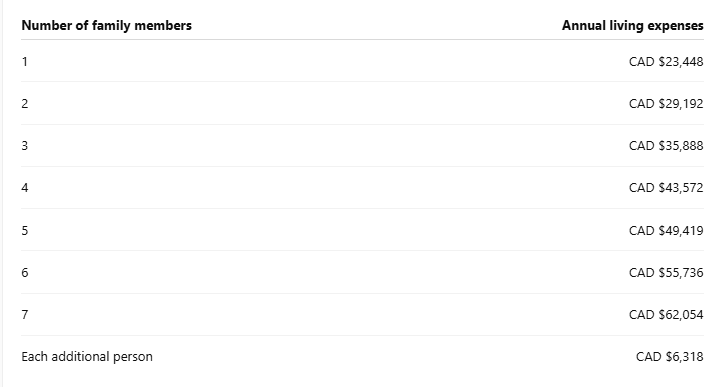
These figures cover living expenses only. You must still add tuition and transportation costs when calculating the total amount you need to demonstrate.
For example, a student travelling with two family members would need at least CAD $35,888 for living expenses for one year, excluding tuition and transportation.
Students planning to study in Quebec should note that different financial requirements apply. Applicants seeking a Quebec Acceptance Certificate (CAQ) must meet the financial requirements set by Quebec’s immigration authorities.
Acceptable Proof of Funds for Canada Student Visa
Having enough money is only part of the requirement. You must also provide documents showing that the funds are available and, where applicable, explaining their source.
IIRCC lists several examples of documents that can be used as proof of financial support, including:
- Bank statements
- Proof of a Canadian bank account
- Guaranteed Investment Certificates (GICs)
- Student or education loans
- Scholarship letters
- Proof of tuition or housing payments
- Recent employment documents and pay slips
- Financial support letters from sponsors
- Proof of income from rental properties
- Financial documents related to pension plans.
IRCC says bank statements from Canadian or foreign accounts covering the past six months can be used as evidence. The statements should include the month you submitted your application or the month immediately before it, and you should provide documentation showing the source of income or funds reflected in the statements.
You do not need to submit every type of document on IRCC’s list. The important thing is to provide enough evidence to demonstrate that you meet the financial requirements.
Can My Parents or Someone Else Sponsor My Studies?
Yes. Your proof of funds does not necessarily have to come entirely from your own bank account.
Parents, relatives, guardians or other individuals can provide financial support for your studies. However, you should clearly demonstrate who is supporting you, their relationship to you, the amount of support they will provide and the source of their funds.
IRCC says a letter from someone providing financial support can include information about their occupation or employment, relationship to you, number of dependants and the amount of financial support they intend to provide. You can also provide evidence of the relationship and proof of the financial support available.
For example, a sponsor’s documents may include bank statements, employment letters, pay slips, business registration documents, proof of income and a sponsorship letter.
Most importantly, your documents should tell a consistent financial story. Your sponsor’s income, bank balance, support letter and relationship to you should support the amount of money being presented as available for your studies.
Can You Use a Scholarship as Proof of Funds to Study in Canada?
Yes. IRCC accepts proof of scholarships as one form of financial evidence.
A scholarship can contribute significantly to your proof of funds, particularly when the award letter clearly states the amount, duration and expenses covered.
A fully funded scholarship that covers tuition and living expenses can reduce the amount of additional money you need to demonstrate. However, if your scholarship only covers tuition, IRCC says you must provide other evidence showing that you have enough money for living expenses and transportation.
Your scholarship letter should clearly show your name, award amount, duration and the expenses covered by the award.
Proof of Funds to Study in Canada for Students from Nigeria
As a Nigerian student, you can use money held in a Nigerian bank account as part of your proof of funds, provided you can demonstrate that the funds are genuinely available to you and explain their source.
Your financial documents may include recent bank statements, evidence supporting significant deposits, your sponsor’s income documents, a sponsorship letter, proof of your relationship with the sponsor, and scholarship or education-loan documents where applicable.
You can use your naira savings when preparing your financial evidence, but you should calculate the Canadian-dollar equivalent when determining whether your available funds meet the requirement. Since exchange rates fluctuate, it is sensible to avoid relying on an amount that is exactly equal to the minimum requirement.
Large or recent deposits should also be properly explained and supported with evidence showing where the money came from. This could include salary records, savings transfers, education loans or other legitimate sources of funds.
Not every asset you own should be treated as readily available cash. A house, land or vehicle, for example, is an asset and does not automatically demonstrate that you have accessible money available to pay your study and living expenses.
Your application should therefore focus on funds that are genuinely available for your education and living expenses. Other assets can provide additional information about your financial circumstances but should not replace evidence of accessible funds.
Proof of Funds to Study in Canada for Students from Nigeria
As a Nigerian student, you can use money held in a Nigerian bank account as part of your proof of funds, provided you can demonstrate that the funds are genuinely available to you and explain their source.
Your financial documents may include recent bank statements, evidence supporting significant deposits, your sponsor’s income documents, a sponsorship letter, proof of your relationship with the sponsor, and scholarship or education-loan documents where applicable.
You can use your naira savings when preparing your financial evidence, but you should calculate the Canadian-dollar equivalent when determining whether your available funds meet the requirement. Since exchange rates fluctuate, it is sensible to avoid relying on an amount that is exactly equal to the minimum requirement.
Large or recent deposits should also be properly explained and supported with evidence showing where the money came from. This could include salary records, savings transfers, education loans or other legitimate sources of funds.
Not every asset you own should be treated as readily available cash. A house, land or vehicle, for example, is an asset and does not automatically demonstrate that you have accessible money available to pay your study and living expenses.
Your application should therefore focus on funds that are genuinely available for your education and living expenses. Other assets can provide additional information about your financial circumstances but should not replace evidence of accessible funds.
How to Calculate Your Total Proof of Funds
To estimate the amount you need, add the following:
- First-year tuition fees
- Required living expenses
- Transportation costs to and from Canada
- Additional funds needed for your actual living costs.
For a single student studying outside Quebec, using the current IRCC figure for applications made on or after September 1, 2026, the basic calculation is:
CAD $23,448 living expenses + first-year tuition + transportation = minimum funds to demonstrate.
For example, if your tuition is CAD $20,000 and your transportation costs are CAD $1,500:
CAD $23,448 + CAD $20,000 + CAD $1,500 = CAD $44,948.
This is an illustration based on the current living-expense requirement. Your actual financial plan should reflect your tuition, travel expenses and the cost of living in your chosen Canadian location.
What Happens If You Have More Than One Year of Study?
If your programme lasts longer than one year, you need to demonstrate that you have enough money for your first year and explain how you intend to pay for the remaining years.
IRCC gives examples such as evidence of a scholarship that extends beyond the first year or proof that your parents are employed.
Your financial plan should therefore show not only how you will start your programme but also how you intend to complete it.
Final Things to Check Before Applying
Proof of funds for a Canadian study permit is not simply about having a particular amount of money in your bank account.
IRCC wants evidence that you can pay your tuition, living expenses and transportation without depending on employment in Canada. It also assesses the amount of money available and its source.
Before submitting your application, calculate your total financial requirement, gather documents showing the availability and source of your funds, and prepare a clear plan for financing the remaining years of your programme if it lasts longer than one year.
Because IRCC updates its financial requirements annually, applicants should always check the latest official figures before submitting a 2027 study permit application.
For the current official requirements, applicants can check the IRCC proof of financial support page before applying.