in group chats, in hushed tones after hospital visits. Recently, that conversation spilled loudly onto social media, with women across the country sharing deeply personal stories about their experiences with male gynaecologists. What emerged was not just a trending topic, but a mirror reflecting the cracks in women’s healthcare in Nigeria.
At the centre of the discussion is a simple but emotionally loaded plea: we need more female gynaecologists.
For many women, visiting a gynaecologist is not casual. It is not routine. It often comes at moments of vulnerability when something feels wrong, when pain refuses to go away, when menstruation becomes unpredictable, when pregnancy brings fear instead of joy, or when infertility threatens dreams long held close. These are moments when empathy matters just as much as expertise.
Yet, in Nigeria, women are frequently met with male gynaecologists—not always by choice, but by necessity. The reality is stark: there are simply not enough female specialists in gynaecology and obstetrics, especially in public and teaching hospitals. And so, women endure, even when they are uncomfortable.
PCOS: More Than a Diagnosis, A Daily Battle
One of the most common reasons Nigerian women find themselves repeatedly visiting gynaecologists is Polycystic Ovary Syndrome (PCOS), also known as PCOV. Medical statistics suggest that one out of every ten women lives with PCOS, making it far more common than many realise.
PCOS is often reduced to a few textbook symptoms—irregular menstruation, acne, weight gain, hormonal imbalance, infertility—but the lived reality is far more complex and exhausting.
Women with PCOS battle hormonal acne that scars not just their faces, but their confidence. They struggle with darkened underarms and necks, visible signs of insulin resistance that attract unwanted stares. Many carry stubborn weight around the midsection despite dieting, exercise, and sheer determination. Fatigue becomes a constant companion. Anxiety, depression, mood swings—these are not side effects, they are daily realities.
And yet, when many women walk into hospitals seeking answers, relief, or even reassurance, they are often met with dismissal.
“It’s just ovulation.”
“Lose weight.”
“You’re overthinking it.”
“Lie down, let’s examine you.”
For a condition that affects mental health, fertility, self-esteem, and long-term wellbeing, being brushed aside cuts deeply.
“The Room Went Blur”: A Hijabi’s Experience
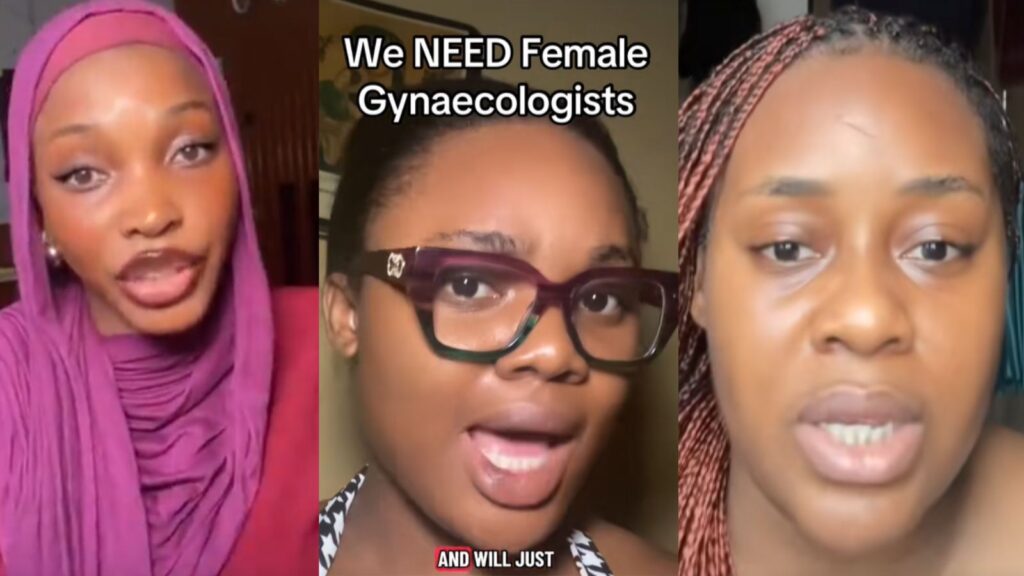
One story that shook many Nigerians was shared by a hijabi woman approaching her third trimester. She recounted visiting a teaching hospital to see her consultant—only to discover that he was accompanied by four other male doctors learning under him.
Five men. One woman. One examination room.
She described how she was asked to remove her trousers and underwear. In that moment, she said, everything went blur. Her hands shook uncontrollably. Fear, modesty, and vulnerability collided at once.
“I started pulling my hands; they were shaking,” she said. “Please, we need girls to start studying gynaecology.”
Her story resonated deeply, especially among Muslim women and others whose cultural or religious beliefs emphasise modesty. For them, the experience is not just uncomfortable—it can be traumatic.
“He Is Teaching What He Has Never Passed Through”
Another woman shared her frustration bluntly:
“I had a male gynaecologist. I was so uncomfortable. He is teaching what he has never passed through. I mean, the pains of a woman.”
@_nowstudios Should men be gynecologists?? #fyp #dating #firstdate ♬ original sound – NOW STUDIOS
This sentiment echoed across social media. Many women do not question the intelligence or training of male doctors. What they question is understanding. Men do not menstruate. They do not experience labour pains. They do not live with hormonal fluctuations that affect mood, skin, weight, and mental health.
While it is true that doctors treat illnesses they have not personally experienced, women argue that gynaecological care is different. It requires not just clinical knowledge, but emotional sensitivity and lived empathy—something many feel is lacking.
@iamamakajessica We need more WOMEN. I know there are amazing male gynaecologists, but right now, except its only in my region… THE VAST MAJORITY of gynaecoligists are MEN! Women please I am begging you. If i had the passion natural and applied sciences, or for the human anatomy, i would have joined science classes back in secondary school. Don’t let media convince you that the world doesn’t need more women in healthcare. We do! Please stay in school and learn more about the female body.
♬ original sound – Amaka Jessica
Dismissal, Discomfort, and Distrust
Several women described a pattern: they gather courage to visit the hospital, explain their symptoms in detail, only to feel mocked, rushed, or ignored. Some say male doctors look at them as though they are exaggerating or “talking nonsense.” Others recount being told to undress abruptly, without explanation or reassurance.
@nayeomi_rob ♬ original sound – Nayeomi ❤️
More troubling are allegations by some women that examinations crossed boundaries—touching felt inappropriate, attitudes were harsh, and dignity was not preserved. Whether these experiences are isolated or systemic, the fear they generate is real. And fear keeps women away from hospitals, worsening conditions that could have been managed early.
@tessyolotta I said what I said I’m no longer comfortable with male gynecologist & doctors
♬ original sound – Lifestyle Creator
A Male Doctor Responds to the Lack of Female Gynaecologists
Amid the outrage, a male doctor posted a video on TikTok defending male gynaecologists. According to him, many female doctors intentionally avoid specialising in gynaecology and obstetrics because they do not want to deal with fellow women.
He went further, claiming that women are emotional beings who cannot tolerate one another, and that men are better equipped to understand and manage them. He concluded by saying that the “meanest people in hospitals are female doctors,” and that men should not be blamed for the lack of female gynaecologists.
@drotedola Why we even need more male gynaes sef #nigeriantiktok🇳🇬🇳🇬🇳🇬❤️❤️🇳🇬🇳🇬🇳🇬 #fy #fypシ゚ #medicalhumor ♬ original sound – drotedola
The Bigger Picture: Women’s Health in Nigeria
This conversation is not about hating male gynaecologists. Many women acknowledge that there are kind, professional, and compassionate male doctors who do their jobs excellently.
What women are asking for is choice.
Choice to be examined by someone who understands their bodies not just academically, but experientially. Choice to feel safe, heard, and respected during some of the most vulnerable moments of their lives. Choice that should not be a luxury.
Nigeria needs deliberate investment in training and supporting more female gynaecologists. Young girls need encouragement, mentorship, and safe learning environments to pursue this specialty. Hospitals need policies that prioritise consent, communication, and dignity during examinations. And doctors—male or female—must learn that listening is as important as diagnosing.
A Final Plea
Women are not asking for miracles. They are asking to be believed. To be treated gently. To be examined with respect. To not feel like an inconvenience or an object on a hospital bed.
“We need female gynaecologists” is not just a trending phrase—it is a call for reform in women’s healthcare in Nigeria. And until it is answered, too many women will continue to suffer in silence.