
In this article, Catalystng.com explains the hierarchy of courts in Nigeria and why understanding the country’s judicial system is important for every citizen.
Courts are regarded as the guardians of justice, responsible for ensuring that disputes are resolved fairly, impartially and in accordance with the law. They are expected to dispense justice without bias, favouritism, emotion or undue technicalities. Beyond being courts of law, they are also courts of equity, committed to ensuring fairness in every case.
One of the fundamental principles that guide the Nigerian judicial system is the right to a fair hearing. As guaranteed under the 1999 Constitution of the Federal Republic of Nigeria (as amended), every person is entitled to have their case heard fairly by a competent court. Where this constitutional right is violated, the entire proceedings may be declared null and void because such a breach amounts to a fundamental irregularity. In determining whether a fair hearing has been observed, the courts apply the standard of a reasonable observer—whether, from the circumstances, justice appears to have been done.
Nigeria operates a constitutional democracy based on the principle of separation of powers. The 1999 Constitution (as amended) divides governmental powers among three arms: the Legislature, the Executive and the Judiciary. Under Section 6 of the Constitution, judicial powers are vested in the courts, empowering them to interpret the law and resolve disputes.
The courts have the authority to hear cases at first instance and determine appeals involving individuals, corporate bodies, governments and public authorities. They adjudicate on matters relating to civil rights, obligations, criminal offences and constitutional issues, ensuring that justice is administered in accordance with the law.
Against this background, this article examines the hierarchy of courts in Nigeria, their respective jurisdictions and the roles they play within the country’s judicial system.
1. Magistrate courts and district courts
Although the Magistrate Court is not established directly by the 1999 Constitution (as amended), it is created by laws enacted by the House of Assembly of each state.
Magistrate Courts primarily handle less complex civil and criminal matters and are generally regarded as courts of summary jurisdiction, where cases are determined through simplified procedures compared to higher courts.
In Southern Nigeria, these courts are known as Magistrate Courts, while in Northern Nigeria, they are commonly referred to as District Courts when exercising civil jurisdiction.
The jurisdiction, powers and procedures of Magistrate Courts are governed by the respective Magistrates’ Courts Laws and Rules of each state, meaning their authority may differ from one state to another.
2. Customary Court of Appeal
Like the Sharia Court of Appeal, Nigeria also has the Customary Court of Appeal of the Federal Capital Territory (FCT), Abuja, and the Customary Court of Appeal of a State.
The Customary Court of Appeal of the FCT is established under Section 265 of the 1999 Constitution (as amended) to serve the Federal Capital Territory, while Section 280 of the Constitution provides for the establishment of a Customary Court of Appeal in any state that chooses to create one.
Each Customary Court of Appeal is headed by a President of the Customary Court of Appeal and comprises the number of judges prescribed by the National Assembly for the FCT or by the relevant State House of Assembly for a state.
These courts primarily exercise appellate and supervisory jurisdiction in civil matters involving questions of customary law, ensuring that disputes governed by customary legal principles are properly reviewed and determined.
3. Sharia Court of Appeal
Nigeria has two categories of Sharia Courts of Appeal: the Sharia Court of Appeal of the Federal Capital Territory (FCT), Abuja, and the Sharia Court of Appeal established by individual states.
Section 260 of the 1999 Constitution (as amended) mandates the establishment of the Sharia Court of Appeal for the Federal Capital Territory, Abuja, while Section 275 allows any state that requires it to establish its own Sharia Court of Appeal.
Each court is headed by a Grand Kadi and consists of the number of Kadis prescribed by an Act of the National Assembly for the FCT or by the relevant State House of Assembly for a state.
The Sharia Courts of Appeal exercise appellate and supervisory jurisdiction over civil cases involving questions of Islamic personal law, ensuring that such matters are determined in accordance with the applicable legal principles.
4. National Industrial Court
The National Industrial Court is established under Section 254A of the 1999 Constitution (as amended). It is headed by the President of the National Industrial Court and consists of the number of judges prescribed by an Act of the National Assembly.
Like the Federal High Court, the National Industrial Court operates through various judicial divisions across different states in Nigeria to ensure efficient administration of justice.
The court has exclusive jurisdiction over civil causes and matters relating to labour, employment, industrial relations, trade unions and other workplace-related disputes, as provided under Section 254C of the 1999 Constitution (as amended).
In addition to its exclusive jurisdiction, the National Industrial Court possesses the powers of a State High Court in matters within its jurisdiction and also exercises appellate jurisdiction in cases as provided by law.
5. The High Court of the Federal Capital Territory (FCT)/State High Court
Nigeria has two categories of High Courts: the High Court of the Federal Capital Territory (FCT), Abuja, and the High Court of each state.
Section 255 of the 1999 Constitution (as amended) establishes the High Court of the Federal Capital Territory, Abuja, while Section 270 provides for the establishment of a High Court in every state of the federation.
Each High Court is headed by a Chief Judge and consists of the number of judges prescribed by an Act of the National Assembly in the case of the FCT High Court, or by the relevant State House of Assembly for a State High Court.
The High Court has one of the broadest jurisdictions under the Constitution, with authority to hear and determine a wide range of civil and criminal matters. It also exercises appellate jurisdiction over decisions of lower courts, including Magistrate Courts, Customary Courts, Area Courts and other courts established by law.
6. The Federal High Court
Like the Court of Appeal, the Federal High Court is divided into several judicial divisions across Nigeria for administrative convenience and currently sits in more than 15 states.
The Federal High Court is established under Section 249 of the 1999 Constitution (as amended). It is headed by the Chief Judge of the Federal High Court and consists of the number of judges prescribed by an Act of the National Assembly. The court is properly constituted when it is presided over by at least one judge.
The court has exclusive jurisdiction over specific civil matters listed under Section 251(1) of the 1999 Constitution (as amended). These include cases involving the Federal Government and other matters assigned to it by the Constitution and other laws.
In addition to its original jurisdiction, the Federal High Court also exercises appellate jurisdiction and possesses all the powers of a State High Court in matters within its jurisdiction.
The court shares concurrent jurisdiction with State High Courts in certain cases, including disputes arising from banker-customer relationships, matters involving the interpretation or application of the Constitution, and the enforcement of fundamental human rights.
7. The Court of Appeal
The Court of Appeal is the second-highest court in Nigeria’s judicial hierarchy, ranking below the Supreme Court. Unlike the Supreme Court, which is located only in Abuja, the Court of Appeal operates through several judicial divisions across different states to ensure easier access to justice.
The court is established under Section 237 of the 1999 Constitution (as amended). It is headed by the President of the Court of Appeal and consists of not fewer than 49 justices at any given time.
The Court of Appeal has exclusive original jurisdiction to hear and determine disputes relating to the election of the President, Vice President, Governor and Deputy Governor of Nigeria.
It also serves as an appellate court, hearing appeals from the Federal High Court, the High Court of the Federal Capital Territory, Abuja, State High Courts, the Sharia Court of Appeal of the Federal Capital Territory, State Sharia Courts of Appeal, State Customary Courts of Appeal, Courts Martial, the National Industrial Court in appropriate cases, and other tribunals established by law.
In addition, the Court of Appeal has the final authority in appeals arising from National and State Houses of Assembly election petition tribunals. Its decisions are also final in appeals involving the civil jurisdiction of the National Industrial Court, as provided by the Constitution.
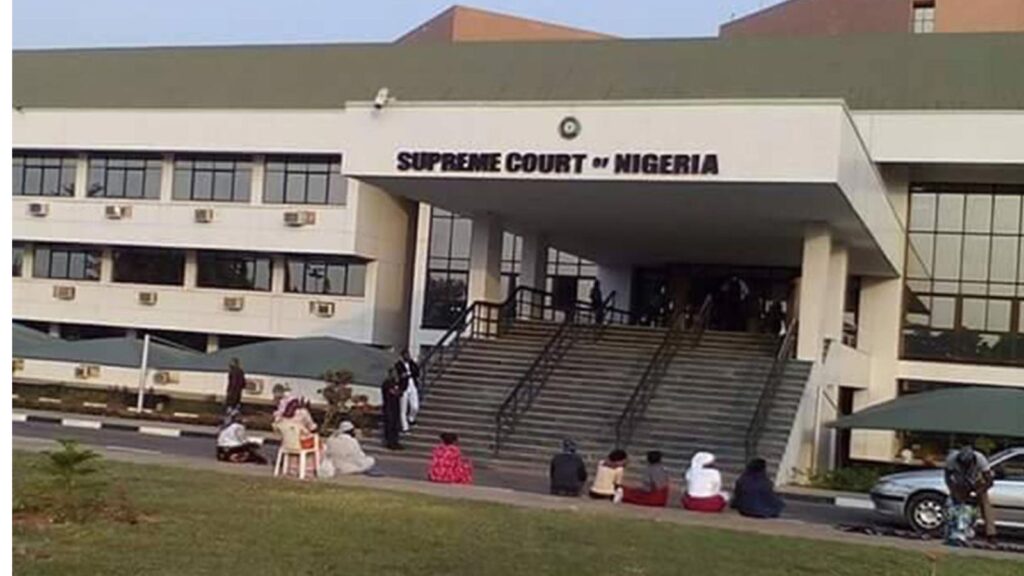
8. The Supreme Court of Nigeria
The Supreme Court of Nigeria is the highest court in the country and the apex of the Nigerian judicial system. It was established in 1963 following Nigeria’s transition to a Federal Republic and the coming into force of the 1963 Constitution, which abolished appeals to the Judicial Committee of the Privy Council, Nigeria’s former highest appellate court.
Today, the Supreme Court is established under Section 230 of the 1999 Constitution (as amended). It is headed by the Chief Justice of Nigeria and consists of the Chief Justice and not more than 21 justices at any given time.
As the country’s highest court, the decisions of the Supreme Court are final and binding on all lower courts in Nigeria. There is no further right of appeal from its judgments. However, this does not affect the constitutional powers of the President or a State Governor to exercise the prerogative of mercy in appropriate criminal cases. In addition, the National Assembly may enact legislation that alters the legal basis of a previous decision, and the Supreme Court also has the authority to depart from or overrule its own earlier decisions where necessary.
The Supreme Court is located in Abuja, the Federal Capital Territory.
The court exercises original jurisdiction in specific constitutional disputes, meaning it is the first and only court empowered to hear such matters. These include disputes between the Federal Government and a state, or between two or more states, where the case involves questions relating to the existence or extent of a legal right.
The Supreme Court does not exercise original jurisdiction over criminal matters. Its primary role is to hear and determine appeals from the Court of Appeal, making it the final court of appeal for all cases in Nigeria.